Russia Confirms Active Talks With Turkey Over S-400 Missile System Fate
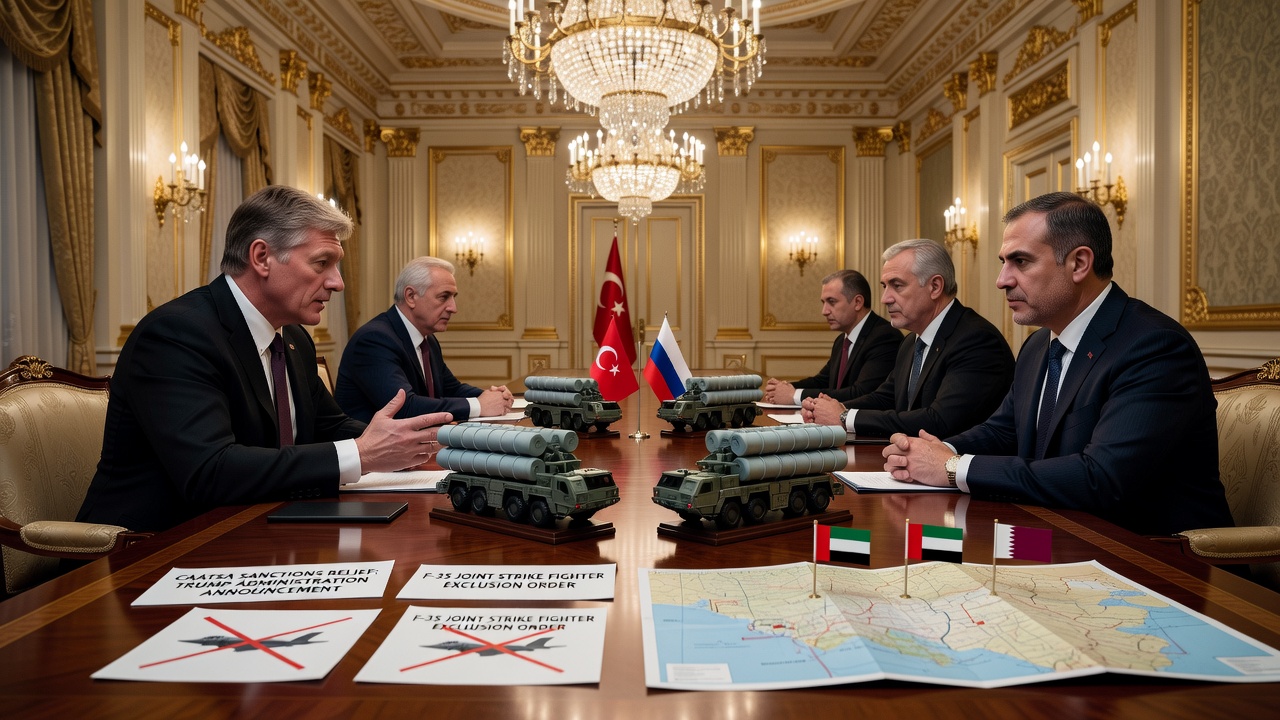
The Kremlin broke its silence on Friday, confirming for the first time that Moscow and Ankara are in active contact over the future of Turkey's S-400 air-defence systems - a diplomatic flashpoint that has strained Turkey's relationship with NATO and the United States for years. The acknowledgement from Kremlin spokesperson Dmitry Peskov came as reports surfaced that Turkey was weighing a potential sale of the Russian-made systems to a Gulf country, with the United Arab Emirates and Qatar named as possible destinations.
The issue has taken on fresh urgency this week after US President Donald Trump announced on Tuesday that Washington would lift arms-sale sanctions imposed on Ankara under the Countering America's Adversaries Through Sanctions Act - known as CAATSA. For those sanctions to be formally removed, Turkey must no longer hold the S-400 systems, a legal condition that effectively forces Ankara to find an exit from a deal it struck with Moscow in 2017. The geopolitical entanglement here is not unlike the complex compliance pressures seen across international governance structures; in sport, for instance, governing bodies have tightened scrutiny over financial rules in ways that reshape how institutions plan long-term commitments. In this case, Ankara must now untangle a security arrangement with enormous strategic and legal consequences.
Peskov, speaking to reporters, declined to confirm directly whether Turkey had sought Russia's consent for a potential third-party transfer, describing the matter only as "an extremely sensitive issue." He did, however, confirm that dialogue is ongoing. "We have been in contact with the Turkish side on this matter, and we will continue our contacts with the Turkish side on this issue," he said, according to RIA Novosti - the first such public statement from Moscow on the subject. The 2017 purchase agreement between Turkey and Russia is understood to include restrictions on where the systems can ultimately be transferred, meaning any Gulf-state sale would almost certainly require explicit Russian approval.
Congress Still the Key Variable in Washington
While Trump's announcement generated momentum, his administration still requires congressional backing to formally lift the CAATSA sanctions. A bipartisan delegation that attended the NATO summit in Ankara earlier this week signalled cautious optimism but stopped well short of certainty. Representative Mike Turner said the details shared with Congress regarding the S-400 arrangement and Turkey's potential re-entry into the F-35 programme "appear to be promising." Senator Jeanne Shaheen, the senior Democrat on the Senate Foreign Relations Committee, was more measured, noting that lawmakers still had "questions to answer" before moving forward. That gap between executive intent and legislative approval remains the central obstacle to a resolution.
Turkey's Path Back to the F-35 Programme
Turkey's exclusion from the F-35 Joint Strike Fighter programme has been the most tangible military consequence of the S-400 purchase. Ankara was removed from the international manufacturing consortium and blocked from acquiring the aircraft after accepting the first delivery of the Russian systems in 2019, making it the first NATO ally to be sanctioned under CAATSA. Turkish Foreign Minister Hakan Fidan, speaking to public broadcaster TRT on Friday, offered measured confidence without disclosing specifics. "We are also taking the necessary steps to resolve this issue," Fidan said. "Hopefully, we will reach a conclusion soon. I don't think there will be any problem with that." Fidan had visited Moscow in June - weeks before the NATO summit - to meet President Vladimir Putin and Foreign Minister Sergey Lavrov, a trip that now appears to have been part of the groundwork for these discussions.
What Comes Next
The convergence of Trump's sanctions announcement, Peskov's public confirmation of ongoing talks, and Fidan's diplomatic signals suggests all parties are working toward a resolution - but the details remain opaque and the timeline uncertain. Turkish journalist Abdulkadir Selvi, writing in Hurriyet and citing government-adjacent sources, reported that Ankara is specifically considering the UAE or Qatar as recipients. Neither Gulf country has publicly commented. Russia's position will be decisive: without Moscow's sign-off on any transfer, the legal and contractual framework of the original deal makes a third-party sale effectively impossible. The Turkish Foreign Ministry had not responded to requests for comment as of Friday. With congressional approval still pending in Washington and Russia's terms still undefined, the S-400 saga enters a new and potentially decisive chapter - but resolution, for now, remains a horizon rather than a destination.