Messi Fires World Cup Hat-Trick to Silence Doubts and Rewrite History
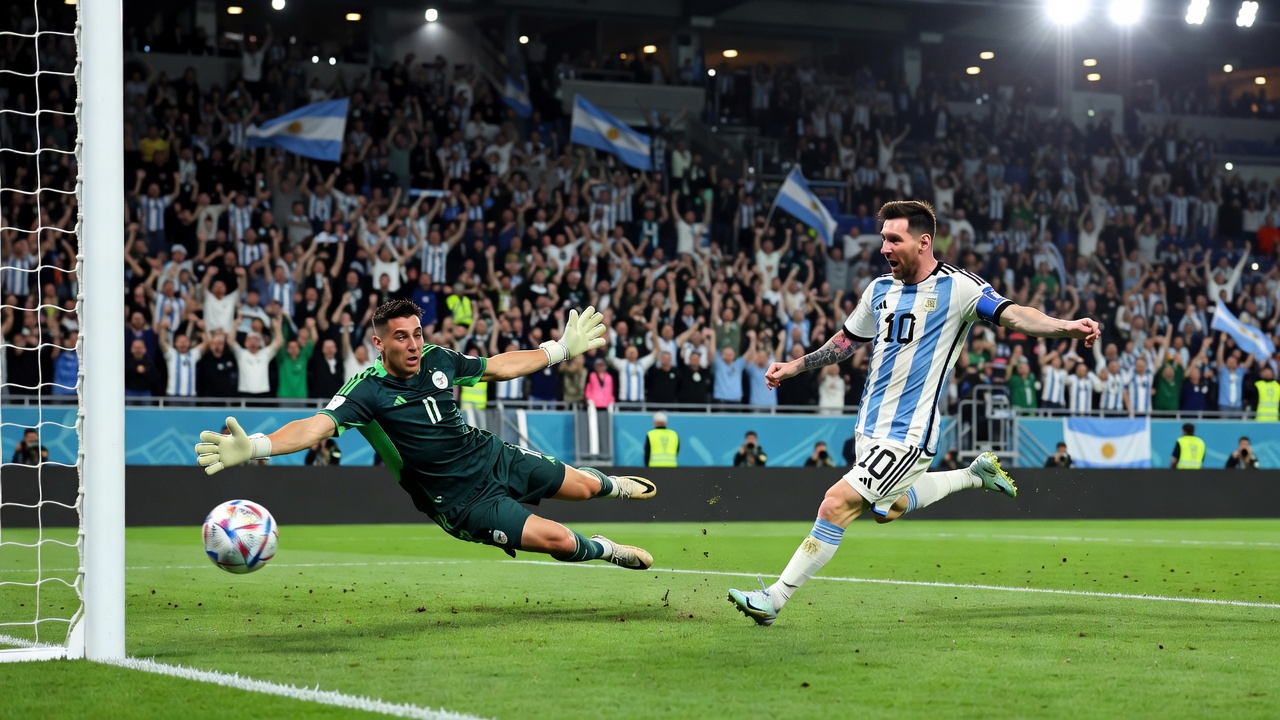
Lionel Messi scored a stunning hat-trick as Argentina beat Algeria 3-0 in Kansas City on Tuesday, announcing himself - emphatically, definitively - as the central figure of this World Cup, just as he was the last. At 38 years old, playing in a sixth World Cup, he moved level with Miroslav Klose at the top of the tournament's all-time scoring charts with 16 goals. The question heading into this tournament was whether the mission had already been accomplished. Tuesday night provided a forceful answer.
There is a wonderful advert running on Argentine television that captures the mood perfectly. On national broadcaster TyC Sport, a staged street interview shows a fan shrugging: "To be honest, after two Copas America and one World Cup, I'm kind of done already." A passer-by interrupts, turns to the camera and delivers a rallying cry. "They say that football owed Messi a World Cup," he says. "Who knows how many it owes him - what if it owes him two?" It is a line that felt hypothetical when the advert was made. After Tuesday, it feels like a serious proposition. The throngs of Argentina supporters lighting up New York's Times Square with chanting and jumping suggested the fanbase was never truly done - and Messi has now given the world reason to pay full attention again, much like fans of other sports who bet on biathlon online seek that same pulse-quickening engagement with competition at its most compelling.
Much was made of Messi's physical condition coming into this tournament. Four seasons in MLS with Inter Miami, and a 39th birthday arriving next Wednesday, had generated genuine uncertainty about whether he could still operate at the elite level this stage demands. The data from Tuesday offered an interesting lens: Messi covered just 6.81km before being withdrawn after 80 minutes, per FIFA figures. Kylian Mbappe covered 9.7km in 90 minutes for France against Senegal. Erling Haaland, not known for his defensive industry, still covered 9.6km for Norway. But those numbers, taken in isolation, tell only part of the story. Messi has never been a high-volume runner. What he does is choose his moments, and when he chooses them, they tend to be definitive.
The Architecture of Three Goals
Algeria packed their midfield to nullify Argentina, and for long stretches it created a congested, scrappy picture. But the first goal illustrated precisely why that approach, while logical, could not ultimately contain Messi. Rodrigo De Paul - still doing the work of two men, still the tireless protector of his captain's vision - found a pass through the middle of four Algerian players, straight to Messi's feet, eliminating the entire midfield in one movement. Lautaro Martinez's run in behind dragged the defence away. Messi, suddenly in open space, stroked the ball into the top corner with the inside of his left boot. The goalkeeper was Luca Zidane - son of France legend Zinedine - who got two hands to the shot and will feel he should have kept it out. That layer of World Cup poetry felt almost scripted.
The second was a study in positioning and anticipation. Messi controlled a long ball from goalkeeper Emiliano Martinez on the left, immediately flicked it in behind for Nicolas Gonzalez, and when the subsequent cross was headed clear to Alexis Mac Allister, Messi was already moving, urging Mac Allister to pass rather than shoot. Mac Allister shot anyway - but Messi anticipated the spill, stayed alert, and stroked the rebound home with his right foot. The hat-trick goal was, as De Paul put it afterwards, an illustration of why the scoreline was perhaps flattering: "It was a difficult game, the scoreline is a bit exaggerated because we have the 10." Three touches in 1.2 seconds to set the ball, body opened, curl into the bottom-left corner. Classic, repeatable, devastating.
The System Around the Magician
Argentina's structure has changed very little since Qatar 2022, and that stability is both a tactical choice and a statement of intent. Mac Allister operates as the midfield metronome, less explosive than he was four years ago but composed and reliable. Enzo Fernandez has grown considerably since his breakout tournament in Qatar and provides the engine alongside him. De Paul, who became something of a viral phenomenon in 2022 for his near-permanent proximity to Messi, remains the heartbeat of the unit - a player who allows others the freedom to create because he will run, press, and cover without complaint. When Algeria had possession, Messi and Lautaro stayed high, cutting off angles rather than pressing. When Argentina had it, the system funnelled the ball quickly to the one player who could unlock any defence on the planet.
History Made, With More Likely to Follow
Beyond the hat-trick, Tuesday carried historic weight. Messi became the first player to appear in six different World Cup editions, edging Cristiano Ronaldo by a day - the Portuguese is expected to feature when his side begin their campaign on Wednesday. He is now level with Klose on 16 World Cup goals, the all-time record. He was tearful at the final whistle, admitting to "some difficult days" away from football without elaborating further. De Paul suggested his friend is playing without the weight that defined his previous four appearances; Qatar in 2022 lifted that burden. What remains is a player, ageing but brilliant, operating with what looks very much like freedom. Argentina, should they replicate what Brazil achieved in 1958 and 1962, would become only the second nation to win back-to-back World Cups. On this evidence, that conversation is entirely legitimate. Nobody, it seems, is done just yet.